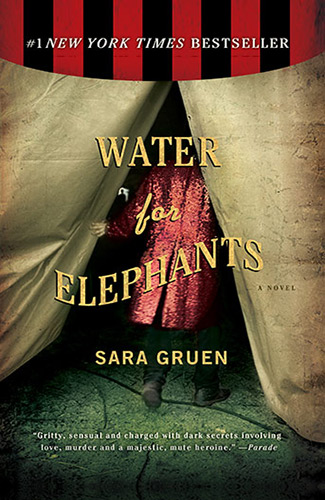
...to break out of teen lit: “Water for Elephants” by Sara Gruen
Many of us almost-adult bookworms are in a weird place, literature wise. We spent childhood wrapped in the warm, colorful embrace of the Barnes & Noble children’s section, where books are neatly separated by age group, reading level and gender, and you can find a stuffed animal to cuddle with as you tear through the seventy-third Captain Underpants book. Then we graduated to the “Young Adult” category, which at my local B&N meant perusing a few shelves directly outside the kid’s section while sipping on a vanilla bean frappuccino and feeling incredibly grown up.
But what now? At 21, I feel icky when I find myself in the teen lit aisle, and it’s gotten hard to take books from a high school freshman’s perspective seriously anymore. At the same time, the regular fiction section isn’t split up as nicely as the kids’ section, and it’s hard to know where to start looking, especially if you have no idea what you’re looking for.
An easy way to get started is with books that have been adapted into movies. Some literary snobs might turn up their noses at this or mutter something about bandwagons, but (usually) popular things are popular for a reason. This strategy opens the door to a large number of books, from classics like “Pride and Prejudice” or “The Great Gatsby” to more current releases like “Gone Girl” or “The Time Traveler’s Wife.” They can be hit or miss as far as how true the adaptation is to the book, but they’re a good way to branch out if you’re stuck in the teen lit rut.
“Water for Elephants” is a Depression-era historical romance told in the narrator’s memories. Jacob Jankowski is a veterinary student who leaves school just short of graduation after being told his parents have died. Distraught and broke, since his parents mortgaged their house to pay his tuition, Jacob runs away and joins the circus as a vet. He falls in love with a performer, Marlena, and does his best to take care of the failing Benzini Brothers Most Spectacular Show on Earth’s animals, subsequently bonding with the new elephant, Rosie. Jacob also tries to stay out of August the equestrian director’s sights to avoid being “red-lighted,” or thrown off the circus train in the middle of the night, but has a hard time with that since August is also Marlena’s husband.
It’s a sweet and heartbreaking read that shows the abuse that went on behind the scenes of circuses, both animal and human. The film adaptation was criticized for a lack of chemistry between Jacob (Robert Pattinson) and Marlena (Reese Witherspoon), and I can’t help but agree that the story and their love comes off the page so much stronger than it does on the screen. If you saw the movie and disliked it, the book is your second chance at a good story. If you liked the movie, you’ll still probably like the book better.
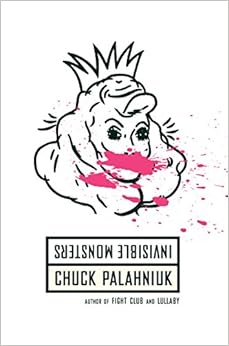
Let’s be honest, anything Chuck Palahniuk writes is kind of a head trip. “Invisible Monsters” was the first novel he tried to publish, but publishers rejected it because it was so disturbing. That’s actually why Palahniuk wrote “Fight Club”—he tried to disturb the publisher even more for rejecting him and ended up writing his most famous novel. “Invisible Monsters” was eventually released in 1999, and it’s not hard to see how it could’ve been rejected. A model goes from having the seemingly perfect life to practically being invisible when her lower jaw is blown off in a gruesome accident on the freeway, leaving her disfigured and practically mute. In typical Palahniuk fashion, our narrator is mostly nameless, save for some fake identities provided by the equally regal and ratchet Brandy Alexander, Queen Supreme and one vaginoplasty away from a full transition. Also in typical Palahniuk fashion, the story isn’t exactly chronological, but at least in “Invisible Monsters” he has the courtesy to let you know. The first sentence in the second chapter reads: “Don’t expect this to be the kind of story that goes: and then, and then, and then.” It jumps around the narrator’s time in the hospital following her accident, where she meets Brandy; her time spent modeling with her terrible best friend, Evie Cottrell; flashbacks to oddly focused parents and a condom-centered Christmas; and road tripping with Brandy and a man with many names, reinventing themselves all the time to steal drugs from houses they pretend to be interested in buying. The story pushes forward, not appearing to really care if the reader keeps up or not. It unapologetically skips between scenes not just between chapters, but also sometimes between paragraphs. It makes brutally honest observations of human nature, like “no matter how much you think you love somebody, you’ll step back when the pool of their blood edges up too close,” and in the next breath remarks how nice of a day it is. It’s Chuck Palahniuk at his finest.
 ...to read Stephen King,
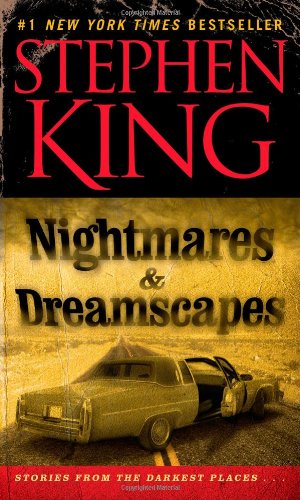
but don’t know where to start: “Nightmares and Dreamscapes” by Stephen King
...to read Stephen King,
but don’t know where to start: “Nightmares and Dreamscapes” by Stephen KingStephen King is both polarizing and daunting. Readers seem to either think he’s a hack or love his storytelling, or else only know him for his works that have been adapted to film. But if you don’t yet have an opinion, where do you start? His Dark Tower series means an eight-book commitment; the buildups in some of his more famous works are probably wasted on you if you know the gist of the story; and the Stephen King section of the bookstore has way too many options.
My introduction to Stephen King was through his short stories. I read “Just After Sunset” first, a collection I jumped around in and never truly finished, always seeming to come back to one particular story whenever I picked it up. When my dad realized I’d delved into one of his favorite author’s work, he presented me with a copy of “Nightmares and Dreamscapes” and offered up his other tomes if I liked what I read.
I did like what I read. The collection of short stories begins with “Dolan’s Cadillac,” the tale of an unassuming teacher exacting dirty, calculated revenge on a Las Vegas gangster for his wife’s death. It’s the kind of story a reader can get behind—good versus evil, rooting for the little guy and a plan for the bad guy to get what he deserves. “The House on Maple Street” is another story in this collection with that kind of feeling. The four Bradbury children discover that something has happened to their house while their family spent the summer abroad, and changes are happening very quickly. The oldest child, Trent, realizes that this mysterious transformation is an opportunity to rid the kids and their mother of Lew, their abrasive and abusive stepfather. King takes a stab at playing Arthur Conan Doyle in “The Doctor’s Case,” telling his own Sherlock tale where Watson steals the show.
Most of the stories are far deeper into the horror genre than these three. “The Night Flier” and “Popsy” feature vampires, a pregnant woman tackles zombies in “Home Delivery” and in “Rainy Season,” a young couple finds themselves to be the latest sacrifice in a small Maine town. “Sorry, Right Number” is horrific in a more heartbreaking way than a scary way, and its screenplay style makes it move a lot quicker than many of King’s works. A set of novelty teeth proves to be the best $3.50 a man ever spends in “Chattery Teeth,” and a couple encounters Rock and Roll Heaven (or hell) in the middle of nowhere, Oregon.
They’re not all winners. King himself notes that “Head Down” is an essay, and while it’s sweet to read about his coaching stint while his kid played Little League, it doesn’t exactly fit with the rest of the stories. I mostly liked Martha’s character in “Dedication,” but it’s hard to get past what she does with the hotel sheets she’s supposed to be tidying. Overall, though, “Nightmares and Dreamscapes” shows off King’s flair for the short story and offers new readers a taste of the worlds he can craft.

No comments:
Post a Comment